How to study effectively: study less, learn more
Andy, PrepLab co-founder · 5 Oct 2026 · Updated 15 Nov 2026
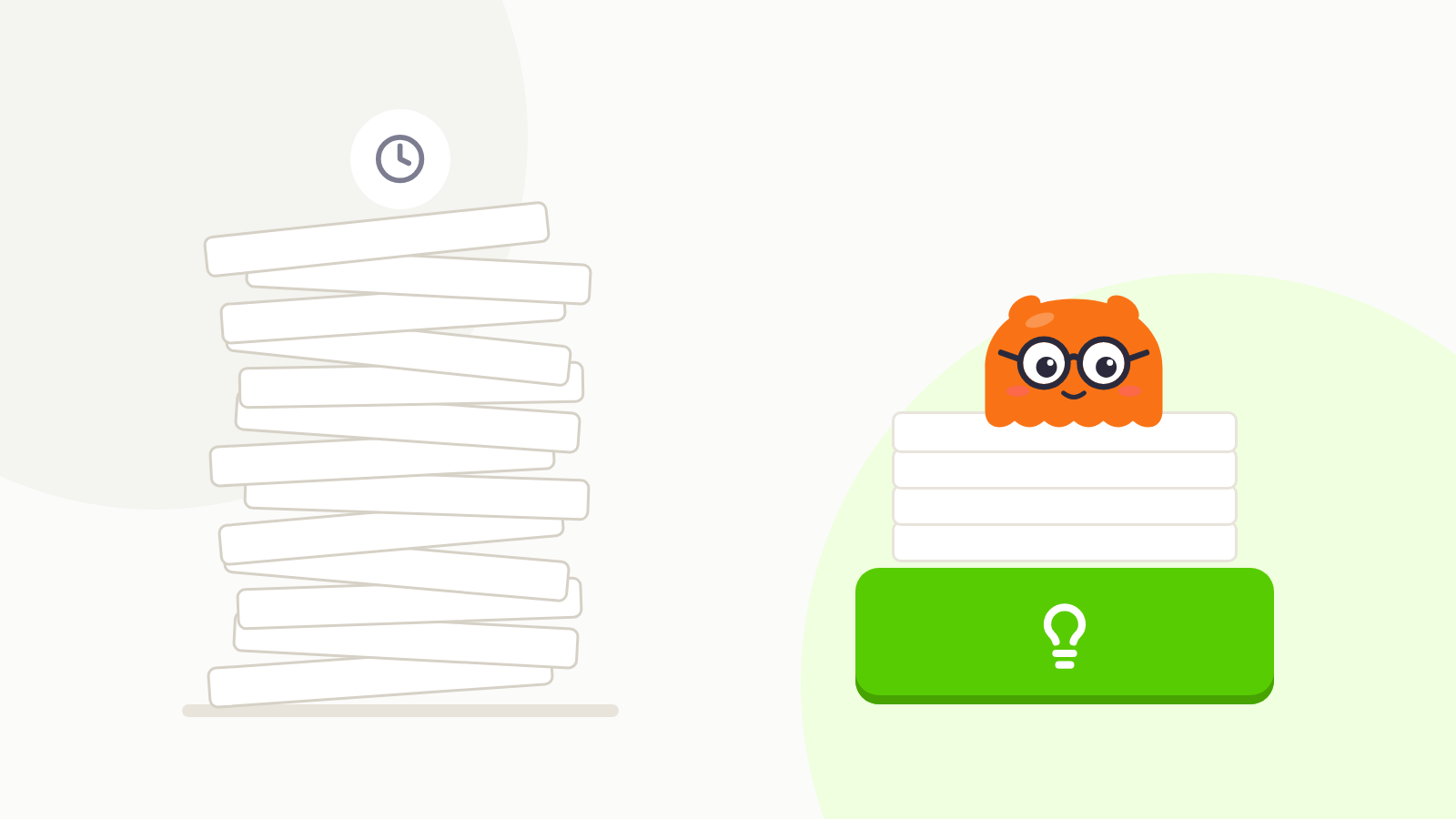
When people ask me how to study effectively, I think of something I got wrong for years. I used to think the students who scored well were simply studying more than everyone else.
Then I met people who seemed to spend fewer hours studying but somehow understood concepts much faster. At first I thought they were naturally smarter. Now I think many of them were simply learning differently.
This is how I think about studying now. It's my own approach, from my own exams, not a study. Where research backs a point up, I've linked it.
More isn't always better
A lot of students focus on quantity. More notes. More papers. More hours. More tuition. More revision.
But more isn't always better. Sometimes the real problem is that the concept never fully clicked in the first place.
It's like building a house on weak foundations. Adding more floors doesn't solve the problem. The foundation still needs fixing.
Whenever a topic suddenly became easy for me, it was rarely because I'd done another ten worksheets. Usually it was because I finally understood one key idea that everything else was built on. The moment that happened, all the other pieces started making sense.
Studying is like training an AI
I've always seen studying as a bit like a machine learning problem.
(A machine learning model is a computer program that gets good at a task by practising on lots of examples, the way your phone learns to recognise faces in your photos.)
There are two parts:
- What it learns from. For a model, that's the examples. For you, it's the explanations: your notes, your teacher, a textbook, a video, a friend.
- How it trains. For a model, that's practice and correction. For you, it's how much you practise, how you practise, and how you fix your mistakes.
A strong model trained on poor examples still gives poor results. Good examples with weak training never reach their full potential. To get great results, both have to be strong.
Many students work very hard on part 2. Long hours reading notes, doing tutorials, memorising answers, finishing practice papers. But effort alone doesn't explain why some students improve faster than others.
The missing piece is often part 1.
Fix what goes in first
Notes aren't just summaries. They decide what examples you see, what intuition you build, what you remember, and what picture of the topic you end up with.
This matters most in science and maths. It's not enough to memorise definitions or copy model answers. You need to know what a concept actually means, why it's true, how it connects to other ideas, and how it shows up in exam questions.
So I went looking for better explanations. Sometimes it was another set of notes, sometimes an assessment book, sometimes a video or a friend explaining it differently. I was looking for the one that finally made me say: "Basically, this is what it means."
That moment matters. After it, the concept is no longer just words on a page. It's something you understand.
My rule of thumb:
- Bad notes make you memorise.
- Good notes make you understand.
- Great notes make you able to explain.
Once you can explain a concept clearly, remembering the key points for the exam gets much easier. The memory isn't floating any more. It's attached to understanding.
(I wrote more about comparing explanations in Your school notes aren't the subject.)
Then practise, the right way
Practice is still important. But it becomes much more effective when there's something solid underneath it.
Practice without understanding is just repetition. Practice after understanding is fine-tuning.
Research agrees that how you practise matters. In a big 2013 review of ten popular study techniques, John Dunlosky and colleagues found that "practice testing and distributed practice received high utility assessments" [1]. In plain words: testing yourself, and spreading your practice out over time. Rereading and highlighting were among the five techniques rated low.
In another study, students who took a recall test on what they'd read did better two days and a week later than students who just studied it again: "prior testing produced substantially greater retention than studying." As Henry Roediger and Jeffrey Karpicke put it: "Testing is a powerful means of improving learning, not just assessing it" [2]. (Those were university students reading passages, not Sec 4s doing maths, but the idea carries.)
So: understand first. Then test yourself with real questions, a little and often.
Maths works a bit differently
Some subjects need less of the "what goes in" and more of the training. For me, that's maths.
Maths isn't as difficult as people think. The formulas and key ideas are few, and secondary maths notes are short. The hard part is getting those ideas so deep in your head that you never break them. The rest is experience in applying them.
Take the discriminant. You can learn in five minutes that a quadratic has no real roots when b² − 4ac < 0. Spotting that a question about a line that never meets a curve is secretly asking about b² − 4ac is the experience part. That only comes from practice.
So in maths, I'd understand the theory first, then practise questions harder than the exam would ask. In my experience, that's what pushed me ahead of my peers. When I was in JC, I often did H3-level and other advanced maths questions, where the concepts go a little deeper and the questions are harder. If you can solve those, what's the hardest exam question going to do to you?
For a Sec 3 or 4 student, the same idea is simple. Once a topic makes sense, don't stop at the questions you can already do. Go after the hardest ones you can find.
What changed for me
One hour spent truly understanding a concept can sometimes be worth more than five hours spent memorising it. That's not a measured number. It's how it felt.
Studying harder is doing more work on the same weak explanations. Studying better is first improving what you learn from, then training your mind properly on it.
I wasn't just trying to absorb whatever I was given. I wanted better explanations, better examples, and a clearer grip on the core idea. Only after that did practice become powerful.
That's when improvement started feeling fast instead of painful.
If you use PrepLab
Every question, workbook and set in PrepLab is rated Basic, Standard or Advanced, so once a topic clicks you can step up to Advanced instead of repeating what you already know. Every wrong answer is saved to your Mistakes, and you can review them by topic. That's the "fix your mistakes" half of the training.
Short daily sets with your friends, and every mistake saved to try again. Free to download on iPhone. Download on the App Store
Sources
- Dunlosky, J., Rawson, K. A., Marsh, E. J., Nathan, M. J., & Willingham, D. T. (2013). Improving students' learning with effective learning techniques. Psychological Science in the Public Interest, 14(1), 4–58. https://doi.org/10.1177/1529100612453266 (abstract opened 2026-11-15)
- Roediger, H. L., & Karpicke, J. D. (2006). Test-enhanced learning: taking memory tests improves long-term retention. Psychological Science, 17(3), 249–255. https://doi.org/10.1111/j.1467-9280.2006.01693.x (abstract opened 2026-11-15)