Learning from mistakes: how to stop making the same ones
PrepLab team · 4 Nov 2026
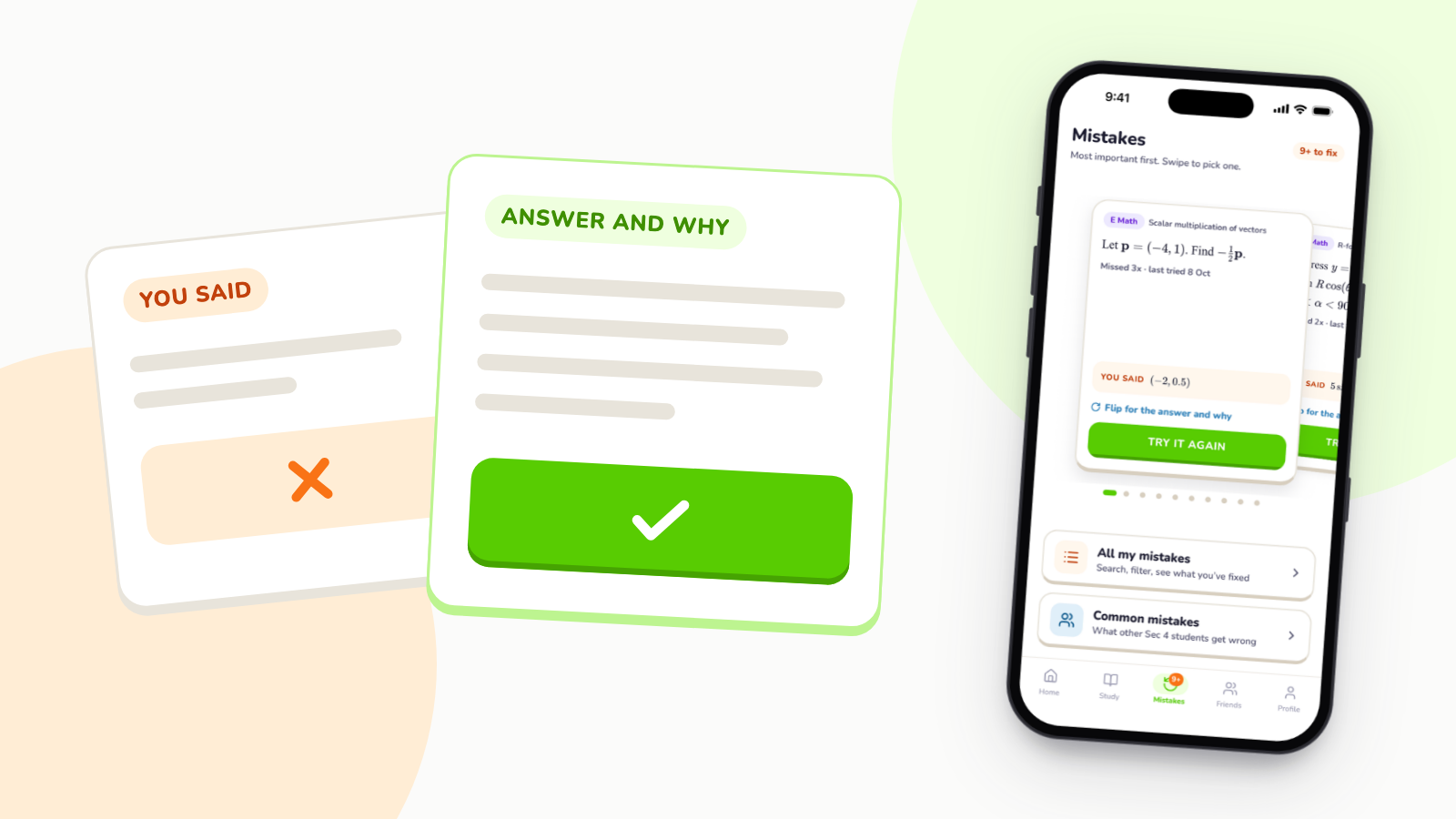
You get your A-Math WA back. Minus two marks for a sign error. Minus three for forgetting the ±. Your teacher writes "careless" in red. You nod, slide the paper into your file, and never look at it again.
Next test: same mistakes.
Everyone tells you to learn from your mistakes. Almost nobody explains how. So here's what the research on learning from mistakes actually says, and a routine that takes about ten minutes a week.
Getting it wrong is part of learning
A lot of teaching used to try to stop students making errors at all. In 2017, psychologist Janet Metcalfe reviewed the lab and classroom studies on this for the Annual Review of Psychology [1]. Her conclusion: making errors and then being corrected beats avoiding errors, as long as the stakes are low, like practice rather than the actual exam.
The correction has to be more than a red cross, though: "Corrective feedback, including analysis of the reasoning leading up to the mistake, is crucial" (Metcalfe, 2017) [1].
So not "wrong, the answer is x² − 6x + 9". More like "wrong, because I expanded (x − 3)² as x² − 9".
One honest caveat: most of these studies used facts and vocabulary, not O-Level maths papers. The idea is well supported. The exact gain for exam maths hasn't been measured.
The mistakes you were sure about are the easiest to fix
Here's the surprising bit. Butterfield and Metcalfe asked people general-knowledge questions, had them rate how confident they were, then showed them the right answer [2]. On a retest, "highly confident errors were the most likely to be corrected". The same effect has been found in children [3].
Researchers call this hypercorrection. One reason it happens: people who are confidently wrong often half-knew the right answer already [4].
John Hattie and Helen Timperley, reviewing the research on feedback, put it like this: "Feedback has its greatest effect when a learner expects a response to be correct and it turns out to be wrong" (Review of Educational Research, 2007) [5].
So the question you were sure you nailed, and didn't? That's not a disaster. That's the best mistake on the page.
The catch: they come back
Butler, Fazio and Marsh tested people again a week later [6]. The correction had faded, and the confident errors were the ones most likely to return: "high-confidence errors were more likely than low-confidence errors to be reproduced on the delayed test" (Psychonomic Bulletin & Review, 2011) [6].
Picture the Physics student who's sure that heavier objects fall faster. Corrected on Monday, fine on Tuesday, wrong again in the EOY.
The fix is simple: correct it once, then test yourself on it again about a week later.
What kind of feedback actually helps
Hattie and Timperley pulled together 12 earlier meta-analyses and found an average feedback effect of 0.79, which they describe as "twice the average effect" of other influences on learning, but the type mattered a lot [5]. Information about the task, and how to do it better, worked best. Praise, rewards and punishment did the least.
A newer and much bigger analysis, 435 studies by Wisniewski, Zierer and Hattie, found a smaller average effect, and a lot of variation: in 17% of cases, feedback made things worse [7]. Feedback isn't automatically good. It has to tell you something useful.
Hattie and Timperley say good feedback answers three questions [5]:
- Where am I going?
- How am I going?
- Where to next?
"Good job!" answers none of them. Neither does "careless".
Have a go before you feel ready
You don't have to wait until you've "learnt it properly" to start answering questions.
- Kornell, Hays and Bjork found that guessing an answer first, then seeing the right one, beat simply reading the question and answer together. Their line: "taking challenging tests-instead of avoiding errors-may be one key to effective learning" (Journal of Experimental Psychology: Learning, Memory, and Cognition, 2009) [8].
- Richland, Kornell and Kao had students answer questions before reading a passage. Their later scores went up, even on the questions they'd got wrong the first time [9].
- In classrooms, this is called "productive failure", an idea Manu Kapur developed in Singapore. A 2021 review of 53 studies found that trying problems before being taught beat being taught first [10]. It didn't hold for younger primary school children, but secondary students are well past that.
Before your teacher starts a new chapter, try two or three questions on it. You'll probably get them wrong. That's the point.
What about "careless" mistakes?
"Careless" makes a mistake sound random. Usually it isn't. Look back at your last three tests and you'll often find the same few: the dropped negative sign, the missing units in Physics, the forgotten state symbols in Chemistry, the copied-down number that changed between lines.
If it happens three times, it's a pattern, not bad luck. And patterns can be practised away.
Do error logs work?
Keeping a mistake journal, or error log, is popular advice. We looked for a controlled study of error logs in secondary school and couldn't find one. So we won't tell you it's proven.
What is backed by research: getting feedback that explains why [1][5], and testing yourself again later [6]. An error log is just a practical way to do both.
A 10-minute weekly routine
- Star the ones you were sure about. Confident misses are the easiest to fix, and the most likely to come back [2][6].
- Write why in one line. Not the right answer. The reason you got it wrong: "forgot to square the 2", "used diameter, not radius".
- Redo it without looking, a few days to a week later. If you get it right, great. If not, it goes back on the list.
- Look for the pattern. Same type of mistake three times? That's next week's practice.
- Try the new chapter early. Two or three questions before it's taught [8][10].
Where PrepLab fits
In PrepLab, every wrong answer goes into your Mistakes tab. Each card flips to show the answer and why, and "Try it again" lets you redo them days later, mixed across subjects. Premium adds Common Mistakes: the questions most students get wrong in each topic, so you can try the traps before they get you in a test.
Short daily sets with your friends, and every mistake saved to try again. Free to download on iPhone. Download on the App Store
Sources
All accessed 2026-11-15.
- Metcalfe, J. (2017). Annual Review of Psychology, 68, 465–489. https://doi.org/10.1146/annurev-psych-010416-044022
- Butterfield, B. & Metcalfe, J. (2001). Journal of Experimental Psychology: Learning, Memory, and Cognition, 27(6), 1491–1494. https://doi.org/10.1037/0278-7393.27.6.1491
- Metcalfe, J. & Finn, B. (2012). Learning and Instruction, 22(4), 253–261. https://doi.org/10.1016/j.learninstruc.2011.10.004
- Metcalfe, J. & Finn, B. (2011). Journal of Experimental Psychology: Learning, Memory, and Cognition, 37(2), 437–448. https://doi.org/10.1037/a0021962
- Hattie, J. & Timperley, H. (2007). Review of Educational Research, 77(1), 81–112. https://doi.org/10.3102/003465430298487
- Butler, A. C., Fazio, L. K. & Marsh, E. J. (2011). Psychonomic Bulletin & Review, 18(6), 1238–1244. https://doi.org/10.3758/s13423-011-0173-y
- Wisniewski, B., Zierer, K. & Hattie, J. (2020). Frontiers in Psychology, 10, 3087. https://doi.org/10.3389/fpsyg.2019.03087
- Kornell, N., Hays, M. J. & Bjork, R. A. (2009). Journal of Experimental Psychology: Learning, Memory, and Cognition, 35(4), 989–998. https://doi.org/10.1037/a0015729
- Richland, L. E., Kornell, N. & Kao, L. S. (2009). Journal of Experimental Psychology: Applied, 15(3), 243–257. https://doi.org/10.1037/a0016496
- Sinha, T. & Kapur, M. (2021). Review of Educational Research, 91(5), 761–798. https://doi.org/10.3102/00346543211019105