Pomodoro technique for students: does it actually work?
PrepLab team · 12 Oct 2026
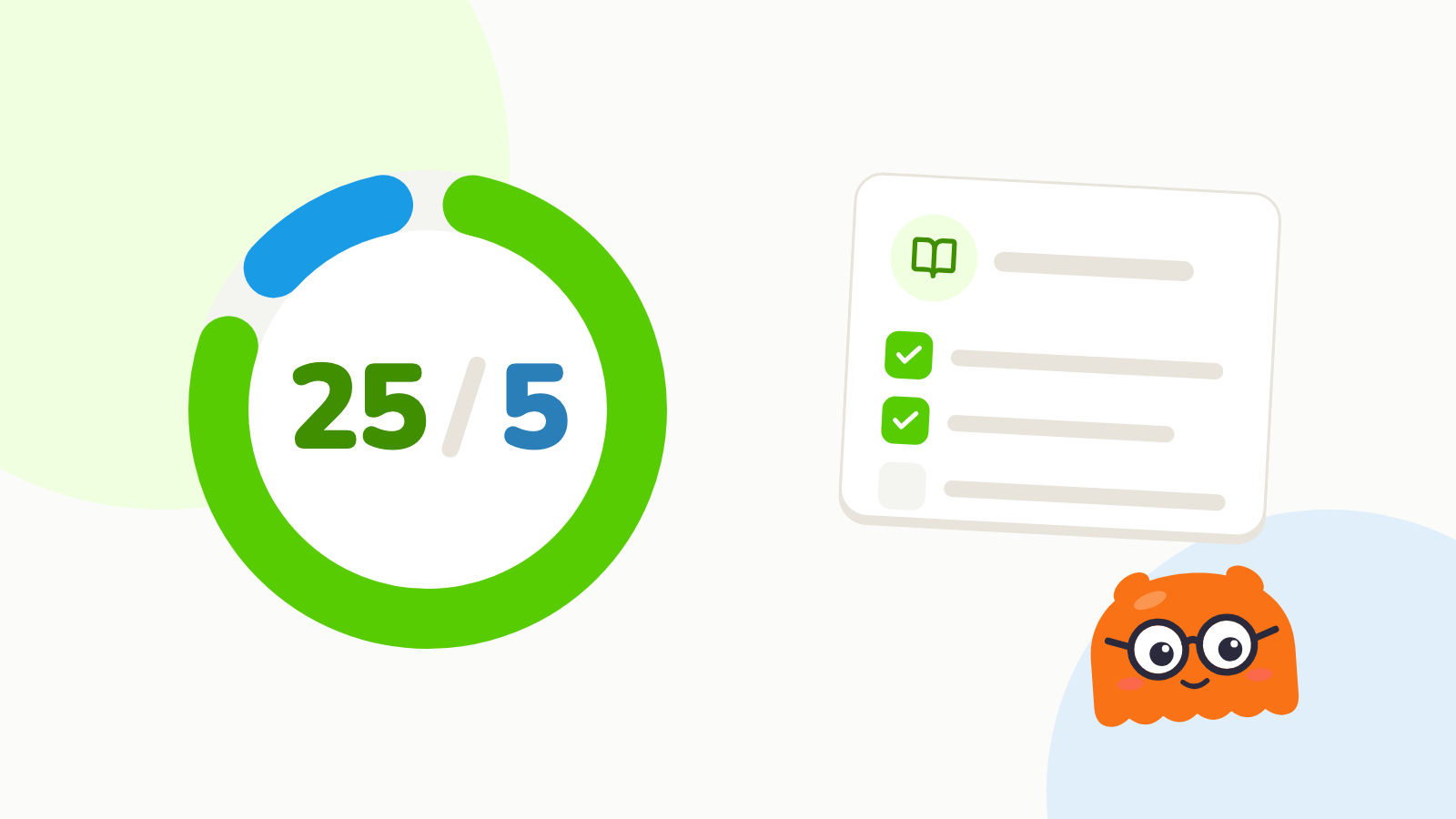
You've seen it on StudyTok: a tomato timer, 25 minutes of focus, 5 minutes off, repeat. The Pomodoro technique for students is probably the most shared study hack online. It's also one of the least tested.
So here's the honest version: where it came from, what the few real studies found, and how to tweak it so it works for a Sec 2 student after CCA, not just a university student with a free afternoon.
What is the Pomodoro technique?
It was created by Francesco Cirillo. According to his official site, he began developing it in the 1980s while preparing for a university exam, using a kitchen timer shaped like a tomato. "Pomodoro" is Italian for tomato [1].
The idea spread for years before the book did. His publisher says an early free PDF was downloaded over 2 million times before Cirillo took it down in 2013. The book, The Pomodoro Technique, came out in 2018 [2].
The classic format:
- Work for 25 minutes on one task.
- Take a 5-minute break.
- After four blocks, take a longer break of 15 to 30 minutes [2][4].
That's it. The timer is the whole tool.
What the research actually says
Short answer: not much, and it's mixed. We couldn't find a single study on Pomodoro with secondary school students, or one that looked at exam results. Nothing shows that 25 minutes is a special number. What exists is two small trials with university students, plus wider research on breaks.
Study 1: it felt better, but didn't get more done
Biwer, Wiradhany, oude Egbrink and de Bruin (British Journal of Educational Psychology, 2023) followed 87 Dutch university students through one real study session. They were split into three groups [3]:
- breaks whenever they felt like it (35 students)
- 24 minutes of study, 6 minutes of break, a Pomodoro-style split (25 students)
- 12 minutes of study, 3 minutes of break (27 students)
The two fixed-break groups said they felt less tired and less distracted, and more focused and motivated. But there was no difference in how much work got done or in how much mental effort it took [3].
The authors' summary: "Taking pre-determined, systematic breaks during a study session had mood benefits and appeared to have efficiency benefits (i.e., similar task completion in shorter time)" [3].
Notice the 12/3 group. Blocks half as long worked just as well.
Study 2: no real difference at all
Smits, Wenzel and de Bruin (Behavioral Sciences, 2025) ran a two-hour session with 94 university students. One group took breaks when they wanted, one used classic 25/5 Pomodoro, and one used a method called Flowtime [4].
Under Pomodoro, tiredness actually rose faster. Overall, though, the researchers found "no differences were found in productivity levels, task completion, and flow" [4]. They also point out that students studied wherever they happened to be, so the setup wasn't tightly controlled.
What about breaks in general?
A bigger review helps here. Albulescu and colleagues (PLOS ONE, 2022) combined 22 samples covering 2,335 people. Short breaks gave a small boost to energy and cut tiredness a bit. The effect on actual performance wasn't significant overall, and only showed up on less demanding tasks [5]. Most of those studies were in workplaces, not schools.
One line from that paper is worth remembering: "recovering from highly depleting tasks may need more than 10-minute breaks" (Albulescu et al., PLOS ONE, 2022) [5]. Translation: after a full A-Math paper, five minutes won't cut it.
There's also a reason breaks might protect focus. Ariga and Lleras (Cognition, 2011) gave 84 people a dull 50-minute lab task. Performance usually drops over a task like that. The group that briefly switched to a second task twice didn't show the drop [6][7]. Alejandro Lleras of the University of Illinois summed it up: "Brief mental breaks will actually help you stay focused on your task!" (University of Illinois, 2011) [7]. That was a boring lab task, not revision, so treat it as a hint, not proof.
So what is it actually good for?
Two things, mostly.
Making studying feel less awful. That's the clearest result from Biwer's study: less fatigue, less distraction, more motivation, same amount done [3]. If revision feels like a grind, that matters.
Starting. This part is our take, not a study. "Revise Chemistry" has no end. "25 minutes of Chemistry, then a break" does. A clear finish line makes it easier to sit down in the first place, which is often the hardest bit.
What it isn't: a proven way to score higher. Nobody has tested that.
How to make Pomodoro work for you
Pick your own block length
Biwer's 12-minute group did as well as the 24-minute group [3]. If you're in Sec 1, or the topic is one you hate (hello, vectors), start with 12 or 15 minutes. Go longer once it feels easy.
Plan the block before the timer starts
Write down one specific thing: "10 questions on simultaneous equations" or "redo the three Physics questions I got wrong on Monday." A vague block turns into 25 minutes of tidying your notes.
Make the break a real switch
Stand up, get water, look out of the window, stretch. Lleras's group did better after switching to a different task [7], and scrolling TikTok tends to swallow the next block too. MOE's phone rules cover school hours [8]; at home, it's on you. Charging your phone in another room during the block helps.
Take a proper long break after hard work
Albulescu's review suggests very draining work needs more than 10 minutes to recover from [5]. After a timed paper or a tough set, take 20 to 30 minutes off before the next block.
Know when to skip it
If you're doing a timed practice paper, don't pause it every 25 minutes; the exam won't. And if you're properly in the zone, nothing says you must stop when the timer rings. Smits's study found self-chosen breaks did just as well [4].
What a real day looks like
A CCA day, Sec 2. Home at 6.30pm, dinner, shower. Two 15-minute blocks of maths with a 5-minute break between, done before 8.30pm. That's 30 minutes of actual work, which beats an hour of half-studying in front of the TV.
The year-end holidays before Sec 3. Three 25-minute blocks in the morning, a long break, done by lunch. Afternoon free. Repeat for a few days a week and you walk into Sec 3 having already met the new subjects.
Where PrepLab fits
PrepLab doesn't have a Pomodoro timer. But each practice set takes about 15 minutes, which happens to be one natural block: do a set, take five minutes off, then do the next. Use any timer you like for the breaks.
Short daily sets with your friends, and every mistake saved to try again. Free to download on iPhone. Download on the App Store
Sources
All accessed 2026-11-15.
- Francesco Cirillo (official site). What is the Pomodoro Technique? https://www.pomodorotechnique.com/what-is-the-pomodoro-technique.php
- Penguin Random House. The Pomodoro Technique by Francesco Cirillo, Crown Currency, 2018-08-14. https://www.penguinrandomhouse.com/books/555557
- Biwer, Wiradhany, oude Egbrink & de Bruin (2023). British Journal of Educational Psychology, 93(2), 353–367. https://doi.org/10.1111/bjep.12593
- Smits, Wenzel & de Bruin (2025). Behavioral Sciences, 15(7), 861. https://doi.org/10.3390/bs15070861
- Albulescu et al. (2022). PLOS ONE. https://doi.org/10.1371/journal.pone.0272460
- Ariga & Lleras (2011). Cognition. https://doi.org/10.1016/j.cognition.2010.12.007
- University of Illinois News Bureau, 2011-02-08. Brief diversions vastly improve focus, researchers find. https://news.illinois.edu/brief-diversions-vastly-improve-focus-researchers-find/
- MOE press release, 2025-11-30. https://www.moe.gov.sg/news/press-releases/20251130-moe-to-introduce-enhanced-measures-to-promote-healthier-screen-use-in-students