Study with friends: why it works, if you do it right
PrepLab team · 2 Nov 2026
You know the library "study session". Four of you, one table, three hours. Work done: one page of E-Math and a very detailed plan for supper.
So is it actually worth it to study with friends? The research says yes, and more than you'd think. But only if it's set up the right way. Here's what works, what doesn't, and how to keep it from turning into a three-hour chat.
Teaming up beats competing
In 2008, Cary Roseth, David Johnson and Roger Johnson pulled together 148 studies on early teens: more than 17,000 students in 11 countries, across 8 decades [1]. They compared three ways of setting goals:
- Cooperative: you do well when the group does well.
- Competitive: you do well when others do worse.
- Individual: your result has nothing to do with anyone else's.
Cooperative won, for grades and for friendships: "higher achievement and more positive peer relationships were associated with cooperative rather than competitive or individualistic goal structures" (Roseth, Johnson & Johnson, Psychological Bulletin, 2008) [1].
And the two went together. Better friendships, better results.
Fine print: most of those studies were group work set by teachers in class, not friends studying after school. But it's not one lucky study. David and Roger Johnson count "more than 1,200 research studies" on cooperative learning [2].
So "who scored highest" is a weaker game than "let's all get through 100 questions this week". The first one only feels good for whoever wins. The second one works for everyone.
Teaching your friend helps you too
When your friend asks why the mole ratio is 1 : 2 and you explain it, that's not time off your revision. It is your revision.
A review of 65 school tutoring programmes by Cohen, Kulik and Kulik found that students who were tutored did better on exams and liked the subject more. The tutors gained too: they understood the subject better [3]. In the authors' words: "tutoring programs have positive effects on children who serve as tutors" (American Educational Research Journal, 1982) [3].
Quizzing each other counts as well. Answering questions from memory, known as practice testing, is one of only two study techniques rated "high utility" in a big 2013 review led by John Dunlosky [4]. Reading your notes out loud to each other isn't.
Friends change how you act, both ways
There's a reason a study session can turn into TikTok in five minutes.
Chein and colleagues had teenagers and adults play a driving game, alone or with friends watching [5]. With friends watching, teenagers took more risks. Adults didn't change. Teens are more switched on to their friends than adults are.
That cuts both ways. Friends can pull you off task, and they can pull you into it. The trick is to point it at the work: a shared streak, a weekly target, a challenge.
Share what you did, not what you'll do
This one's a bit unexpected.
Peter Gollwitzer and colleagues found that when other people noticed someone's goal, like "I'm going to be a lawyer", that person then acted on it less [6]. They got a "premature sense" of already being there. Their words: "Identity-related behavioral intentions that had been noticed by other people were translated into action less intensively than those that had been ignored" (Psychological Science, 2009) [6].
Those were university students and big life goals, not homework. But it's worth borrowing.
So in the group chat:
- Less of: "This weekend I'm finishing ALL of Chapter 5 Chem."
- More of: "Did 20 questions on Chapter 5. Got 6 wrong. Fixing them now."
The second one is true, it's specific, and it quietly makes everyone else want to open their books too.
How to keep it from turning into a chat
Our tips, built on the research above:
- Keep it small. Two to four people is easier to keep on track than a whole class.
- Agree the goal before you start. "30 questions each, then supper." Not "let's study".
- Everyone does their own work. Sitting next to the person who's actually doing the questions doesn't count.
- Learn brand-new topics alone first. Then practise them together.
- Quiz each other. Swap questions, mark each other's answers, explain the ones someone got wrong.
- Deal with the group chat, not just the phone. You may have heard that just having your phone on the desk drains your brainpower. That claim comes from a 2017 study [7] that didn't hold up when it was repeated: a 2022 replication found no difference by where the phone was. In its words, "the mere presence of one's smartphone may not be enough to affect cognitive performance" (Ruiz Pardo & Minda, Acta Psychologica, 2022) [8]. The real problem is using it. Mute the chat for 30 minutes.
Can't meet up? Study together anyway
Different schools. Different CCA days. One of you lives in Pasir Ris and the other in Jurong West. Meeting at the library every week isn't happening.
You don't need to be at the same table. What made the research work was the shared goal and everyone doing their part, not sitting next to each other. Fifteen minutes each, on your own phones, counting towards one target, gets you most of the way.
Where PrepLab fits
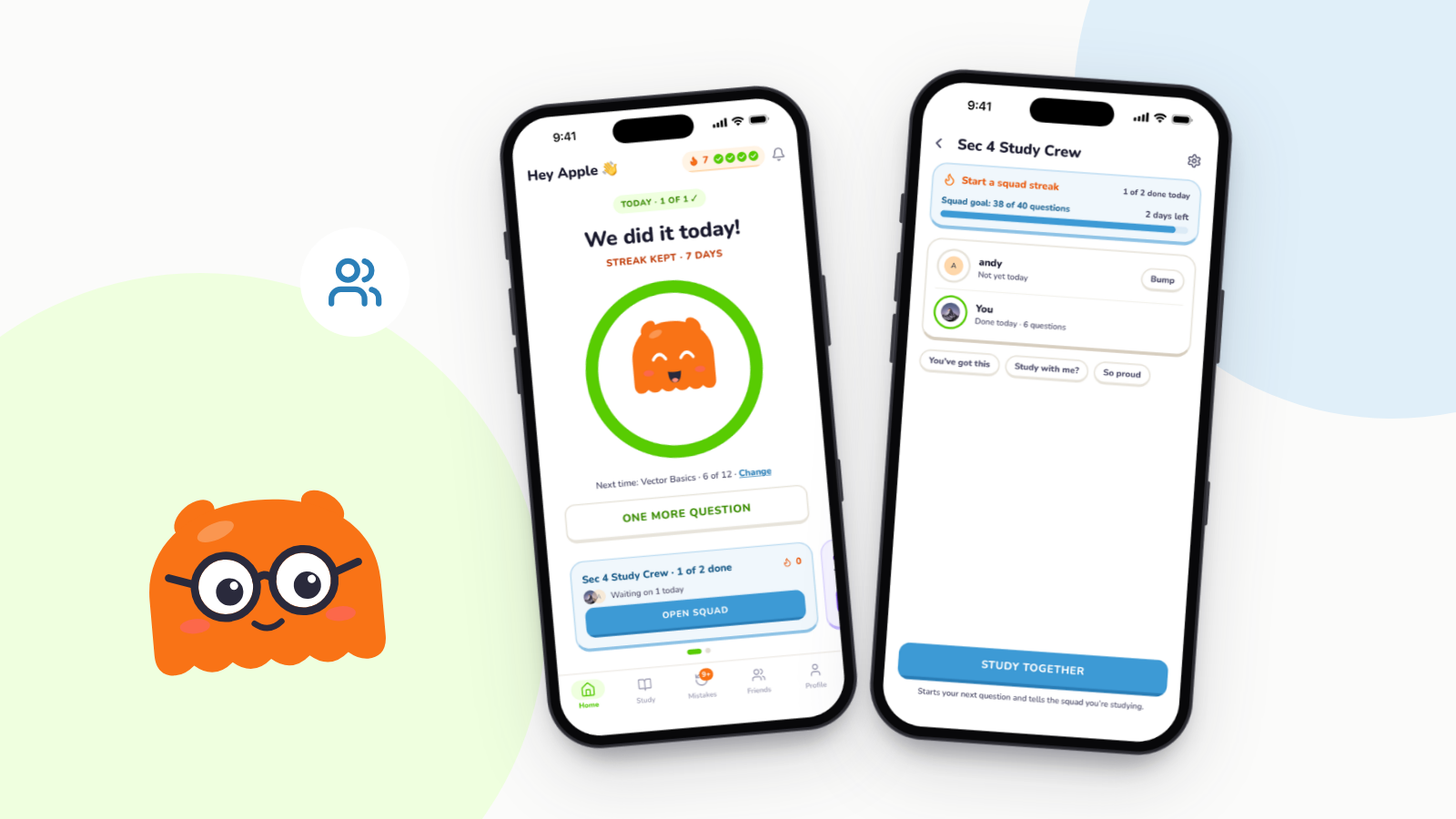
That's what squads in PrepLab are for. Make a squad of 2 to 8 friends (you can be in up to 3). You share a weekly question goal and a squad streak, and the streak only keeps going if everyone shows up. You can see who's studying right now, bump anyone who hasn't started, and send a friend a challenge that ends after 24 hours.
It's the research above, set up for you: one shared goal instead of a ranking, and your squad sees who's done today, not who promised to.
Short daily sets with your friends, and every mistake saved to try again. Free to download on iPhone. Download on the App Store
Sources
All accessed 2026-11-15.
- Roseth, C. J., Johnson, D. W. & Johnson, R. T. (2008). Psychological Bulletin, 134(2), 223–246. https://doi.org/10.1037/0033-2909.134.2.223
- Johnson, D. W. & Johnson, R. T. (2009). Educational Researcher, 38(5), 365–379. https://doi.org/10.3102/0013189X09339057
- Cohen, P. A., Kulik, J. A. & Kulik, C.-L. C. (1982). American Educational Research Journal, 19(2), 237–248. https://doi.org/10.3102/00028312019002237
- Dunlosky, J., Rawson, K. A., Marsh, E. J., Nathan, M. J. & Willingham, D. T. (2013). Psychological Science in the Public Interest, 14(1), 4–58. https://doi.org/10.1177/1529100612453266
- Chein, J., Albert, D., O'Brien, L., Uckert, K. & Steinberg, L. (2011). Developmental Science, 14(2), F1–F10. https://doi.org/10.1111/j.1467-7687.2010.01035.x
- Gollwitzer, P. M., Sheeran, P., Michalski, V. & Seifert, A. E. (2009). Psychological Science, 20(5), 612–618. https://doi.org/10.1111/j.1467-9280.2009.02336.x
- Ward, A. F., Duke, K., Gneezy, A. & Bos, M. W. (2017). Journal of the Association for Consumer Research, 2(2), 140–154. https://doi.org/10.1086/691462 (original study; its main finding did not replicate, see 8)
- Ruiz Pardo, A. C. & Minda, J. P. (2022). Acta Psychologica, 230, 103717. https://doi.org/10.1016/j.actpsy.2022.103717